Artificial Intelligence in the group behavior of robots
Build your business with us
 Artificial Intelligence in the group behavior of robots
The most economically attractive applications of mobile robots problems related to their massive use over large areas. In such circumstances, it is not possible to obtain reliable and sufficiently complete knowledge about the environment where the robots has to solve the problem. Solving problems with incomplete initial data and difficult to formalize the terms refer to the problems of artificial intelligence.
Consider the conditions that can contribute to the formation of artificial intelligence in a group of robots. Lack of knowledge and experience of the individual robot we will try to compensate for the collective experience and knowledge of the aggregate group of robots.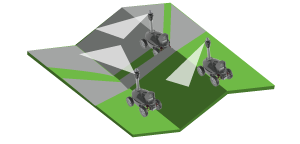
Global task assigned to group robots can be divided into sub-tasks in order to better suit the capabilities are not modernized hardware of their robot solution. For example, the robot requires communication antenna for maximum extension, and transportation robot require maximum load capacity, respectively, the design of these robots can vary significantly. Those groups of specialized robots focused on solving specific problems. Moreover, the more accurate will be formulated set for the robot task, the more will be able to offer an effective solution to the robot designers.
For the successful implementation of specialized robots tasks needed reliable data about the environment in which these tasks are performed. As work over a wide area involves interaction with other members of its use. Also possible natural exposure. This environment is not stable, and changes in it will be a matter of a completely ordinary, from the rain, which resulted in part of the path may become unavailable, and ending with a car that will block known route of the robot.
We want to protect that these changes do not lead to a fatal amount of time in the solution of the problem group of robots.
It requires two components: a reliable communication channel between each robot individually and as a whole group, and a common language describing the environment. In our case, we can talk about a multi-layer map because the primary location and all the external characteristics logically tied to it. As for the link, it seems a rational use of wireless, self-organizing MESH networks applying for the organization of a continuous zone of radio coverage of mobile repeaters, whose task was to establish radio and network connections with remote robots.
Indeterminacy of the environment suggests that the robot may not be able to perform the tasks. Consequently, it is necessary to have an excessive number of robots. In addition, it can always be circumstances where it is necessary the maximum number of robots to effectively perform the task. For example, weather conditions resulted in swelling of the soil, which is caused by movement of the high cost of energy, resulting in larger than usual portion of robots has been out of operation for charging batteries. In these conditions, excessive number of robots needed. At the same time, it allows you to dynamically allocate tasks and form coalition’s robots for optimal strength.
Each of the robots is an intelligent agent. Along with the special, peculiar only to this class of robots, tasks such robot solves the same for all mobile robots problem. Such as your location, motion control, the choice of the optimal path of travel, forecasting the path of the bypass and other vehicles. All these tasks is permanent search of optimal solution.
The regular autopilot of the robot programmed for standard maneuvers solutions on the route. At the same time, under favorable external conditions (for example, an excess of the calculated time allotted for the solution of the problem) might introduce an element of chaos, with the expectation that it will be able to lead to a new decision, the best available.
Under normal conditions, the robot moves along the route with a minimum deviation, at the same time, the calculation of energy consumption on the path length shows that the efficiency of the movement is far from optimal. With sufficient battery charge, the program will instruct the robot to deviate from the current route in one direction or another, the probability to pass the same area with less energy. In this case, the robot will report an improvement over the route of the intelligent agents of the coalition. In this way, implemented genetic algorithms and reinforcement learning, along with a predetermined program of the robot.
It would seem a little effect as the optimization of the task at the level of an intelligent agent in multi-robot system produces a synergistic effect of self-organization, which allows time to solve the global problem of optimal way. Actually this decision and will wear signs of Artificial Intelligence in the group of robots.